Comms modules
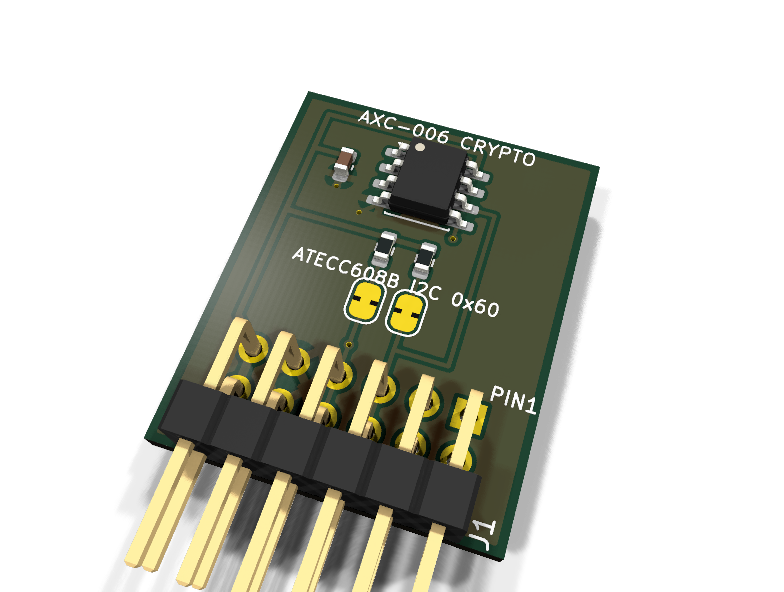
AXC-006 — ATECC608B crypto element PMOD module
Catalog #6 in the AruviX comms line, level L3 (I2C). Microchip ATECC608B secure element: hardware ECC P-256 keys that never leave the die. Anchors the security mini-curriculum with AXC-001..004 (and the deferred fingerprint carrier in the sensor-line backlog).
Circuit review & bench-test guide →
Components#
Every placed component, with the reason it is on the board. Extracted directly from the schematic, so this cannot drift from the design.
| Ref | Value | What it does on this board | Part number | Footprint |
|---|---|---|---|---|
C1 |
100nF 16V X7R | U1 decoupling | GRM188R71C104KA01DMurata |
C_0603_1608Metric |
J1 |
PMOD PLUG 2x6 | PMOD peripheral plug (Digilent spec 1.2) | not selected generic |
PinHeader_2x06_P2.54mm_Horizontal |
JP1 |
SDA PULL-UP | Cut to remove the SDA pull-up when chaining modules | — | SolderJumper-2_P1.3mm_Bridged_RoundedPad1.0x1.5mm |
JP2 |
SCL PULL-UP | Cut to remove the SCL pull-up when chaining modules | — | SolderJumper-2_P1.3mm_Bridged_RoundedPad1.0x1.5mm |
R1 |
4.7k | I2C SDA pull-up | RC0603FR-074K7LYageo Datasheet ↗ |
R_0603_1608Metric |
R2 |
4.7k | I2C SCL pull-up | RC0603FR-074K7LYageo Datasheet ↗ |
R_0603_1608Metric |
U1 |
ATECC608B-SSHDA-T | CryptoAuthentication secure element, ECC P-256, I2C, SOIC-8 | ATECC608B-SSHDA-TMicrochip Datasheet ↗ |
SOIC-8_3.9x4.9mm_P1.27mm |
Signals#
Net labels used in the schematic, which are also the names the HDL top level should use.
3V3 GND SCL SCL_PU SDA SDA_PU
Production status#
| Schematic ERC | 0 violations |
|---|---|
| PCB layout | complete |
| DRC | 0 violations |
| Fab package | exported (24 gerbers + drill + CPL + BOM) |
| Fabricated | no — design stage only |
Source: boards/comms-modules/axc-006-crypto
Catalog #6 in the AruviX comms line (../README.md), level L3 (I2C). Microchip ATECC608B secure element: hardware ECC P-256 keys that never leave the die. Anchors the security mini-curriculum with AXC-001..004 (and the deferred fingerprint carrier in the sensor-line backlog).
Status: schematic generated, ERC clean (0/0), netlist reviewed. PCB layout not started. Not released.
What it teaches#
Secure boot (verify AruviOS images), signing (sign telemetry before AXC-003 publishes it over MQTT), peer authentication for the radio modules, and a non-trivial I2C driver: the wake-pulse protocol quirk — the part sleeps hard, and a plain START does not wake it. The driver must hold SDA low for
60 µs (tWLO), release, wait 1.5 ms (tWHI), then poll for the 0x11 wake
response. The atecc_i2c HDL core owns this sequence.
Design#
- Standard AXS I2C pattern: 4.7 k pull-ups behind JP1 (SDA) / JP2 (SCL) solder jumpers, bridged by default — cut when another chained module provides the pull-ups. Bus repeated on PMOD pins 9/10 for daisy-chaining.
- Address convention, stated clearly: the datasheet's 0xC0 is the 8-bit write address; in 7-bit terms (what AruviOS drivers use) the device is at 0x60. Fixed — no address jumper exists for this part.
- SOIC-8 (
ATECC608B-SSHDA-T); pins 1–3 and 7 are true no-connects. - 100 nF decoupling; 3.3 V only.
| PMOD pin | 1 | 2 | 3 | 4 | 5 | 6 | 7 | 8 | 9 | 10 | 11 | 12 |
|---|---|---|---|---|---|---|---|---|---|---|---|---|
| Net | NC | NC | SCL | SDA | GND | 3V3 | NC | NC | SCL | SDA | GND | 3V3 |
Regenerate#
python3 generate_design.pyRemaining for release#
- [ ] PCB layout (20 × 25 mm outline), DRC, fab outputs
- [ ]
hdl/:atecc_i2ccore with wake-pulse handling, testbench - [ ] Provisioning lesson: slot configuration is one-time-lockable — write the config walkthrough before anyone locks a dev board by accident
- [ ] BOM export and availability check, design-review checklist